

The Revenue Cycle Issue Your Billing Team Can't Fix

When revenue cycle performance slips, the instinct for many practices is to look at the billing team. Are claims going out on time? Is the denial queue getting worked on? Are staff following up quickly enough?
Those are reasonable questions. In many cases, people working the revenue cycle are doing exactly what the system allows, so it is the problem. Revenue cycle configuration in your practice management shapes what gets captured, how claims get routed, and what your team can actually see. When that configuration is off, the downstream impact is financial leakage that billing staff cannot resolve, no matter how hard they work.
This is one of the most common patterns we see at TempDev. Organizations experiencing persistent revenue cycle problems are often not facing a people problem but a configuration problem.
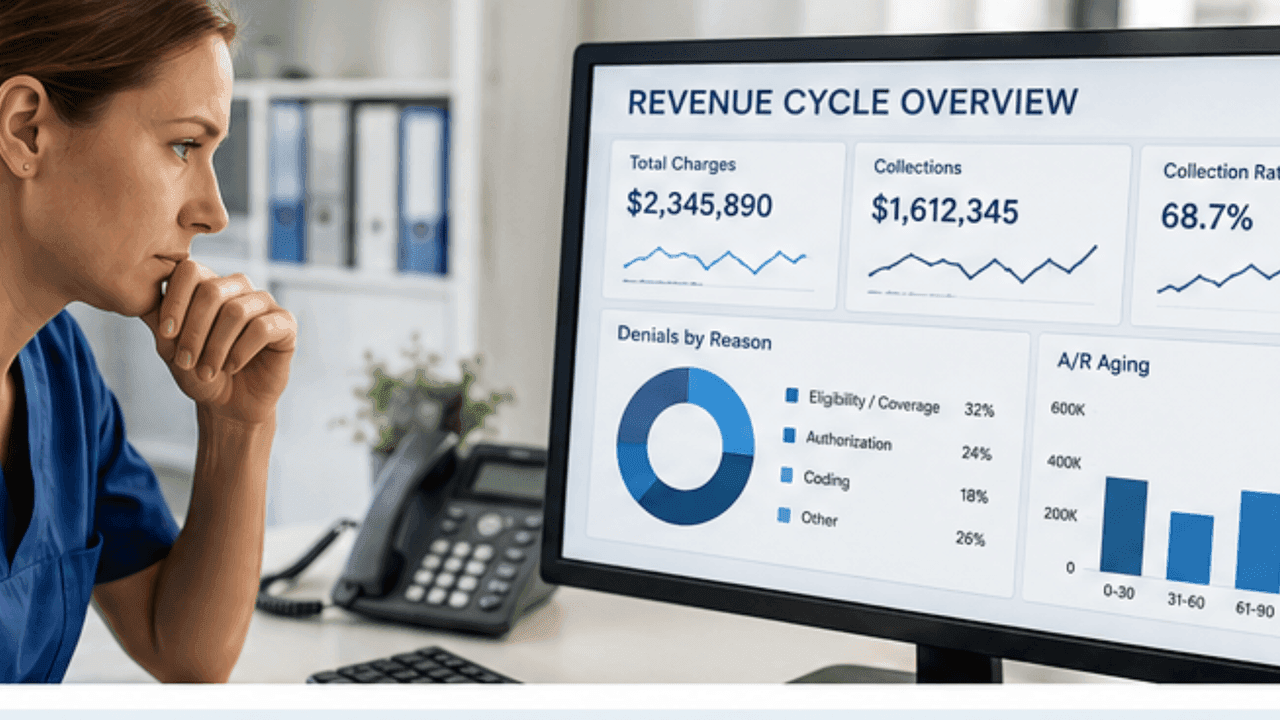
Why Billing Teams Tend to Inherit Upstream Revenue Cycle Problems
By the time a claim denial or charge failure happens, the root cause of the problem has already occurred. This decision point could have taken place when scheduling, at registration process, during documentation, or inside a system workflow that nobody has checked in ages.
Here are some possible examples. AN ERA comes in and posts money to a voided charge and the employees working credit balances don't have permissions to fix it.
A NextGen contract writes a charge off at charge entry incorrectly because the charge is actually billable, or an incorrect insurance was chosen.
All of these problems fall into the revenue cycle configuration issues category and create corresponding revenue cycle problems that billing teams have to deal with afterward.
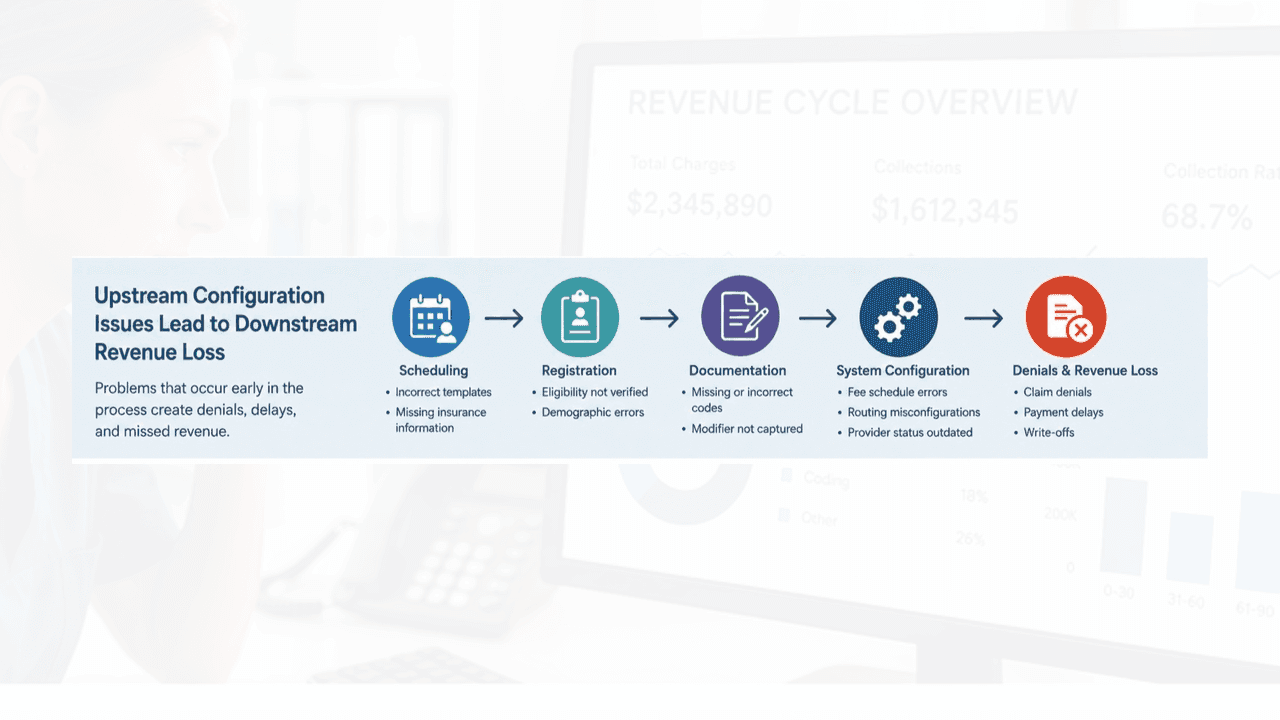
As MGMA found, the most common causes of revenue cycle leakage are denials and appeals (48%), front-end issues (23%), and charge posting (2%).
Configuration Issues Affecting Claims and Payments
Revenue cycle configuration affects the whole claim life cycle. Some relevant aspects here include:
Payer contract mapping. When contracts are misapplied to payers, or contract amounts are adjudicated at charge entry, and they're wrong, reimbursement is going to be off.
Claim routing rules. Improperly configured routing may lead to incorrect routing of claims that will inevitably result in systematic denials.
Eligibility checking configuration. Incorrect setup of the checking process will cause front desk staff to fail to catch any potential coverage issues before the actual patient visit.
Enrollment/credentialing status check-up. This configuration issue may occur due to incorrect enrollment or credentialing statuses for the providers in question.
Modifier/procedure code rules. Failure to configure modifier and procedure code rules will eventually prevent charges from being properly captured and sent out, thus draining your practice revenues.
As noted earlier, all these examples represent revenue cycle configuration issues that sit upstream from the billing workflow. Trying to fix such an issue as a downstream symptom will only make it reproduce again and again.
Workflow Design Impact on Charge Capture
If templates aren't built correctly, they may capture the wrong code or skip required modifiers, quantities, or NDC codes entirely. Those errors work their way downstream until claims start rejecting or denials come back. Then, your team is reworking charges that should have been clean from the start.
Why Reporting Should Identify the Cause of the Problem
One of the reasons why revenue cycle configuration issues tend to recur is that legacy reporting cannot identify these issues in the first place.
Before you can act on denial trends, you need to start by configuring your ‘Reason codes’ to accurately track denials. If denials aren't being categorized correctly in the first place, your reporting is already working with bad data.
Once reason codes are set up properly, have a good dashboard that surfaces the patterns: which payers are denying, for what reasons, and how often. That's where the real work begins. Because once you can see the trends, the next step is tracing them back upstream and addressing the root cause, whether that's missing authorizations, credentialing gaps, or something else in the workflow.
That upstream focus is what separates teams that are constantly working on denials from teams that are actually reducing them. That's how we approach revenue cycle optimization at TempDev. We get the data right, build the visibility, then work backward to prevent the problem from generating itself again.
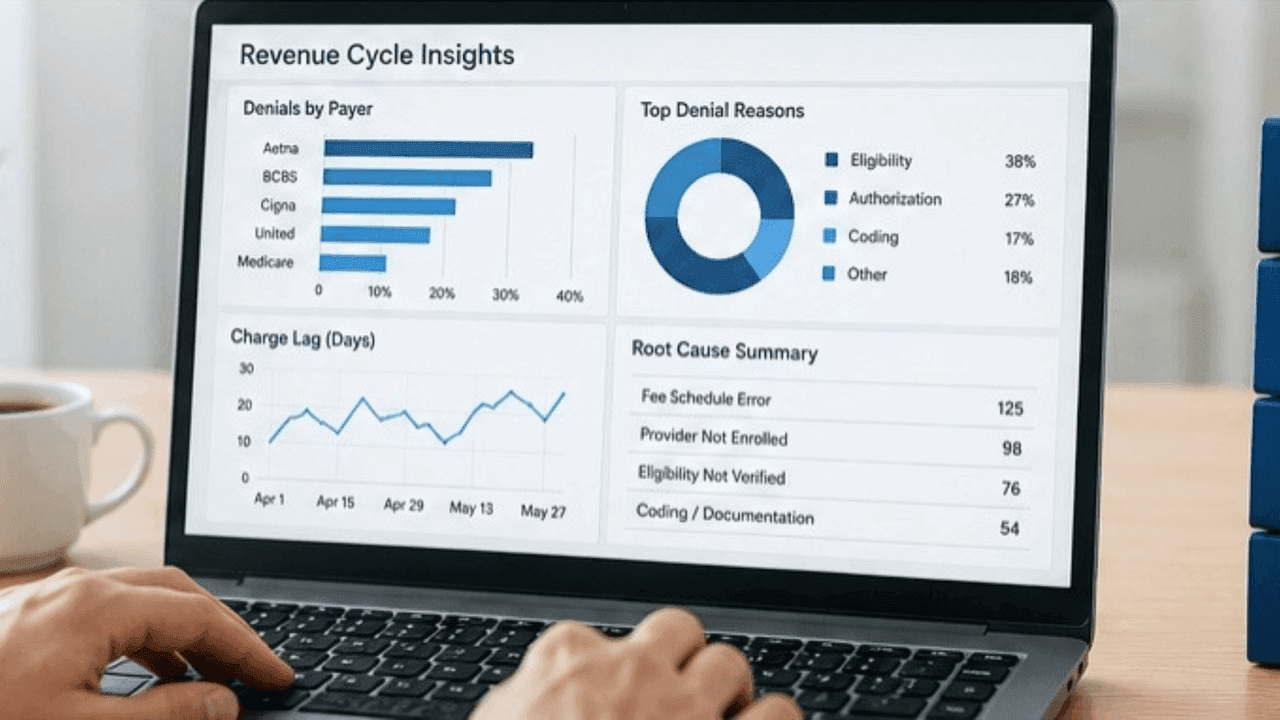
How Assessment Can Help Uncover Configuration Root Causes
The trouble with configuration-related problems in healthcare billing is that they often tend to be confused with other issues. High denial rate, are likely to be thought of as resulting from poor coding. Charge lag is viewed as a documentation problem; eligibility checking failure is considered a front desk issue. All of these require an assessment performed by specialists experienced in both workflows and configurations.
A revenue cycle configuration assessment examines the full picture:
How your practice management system is set up
How claim routing is configured
Where charge capture logic may be breaking down, and
Whether your reporting gives you the operational visibility you need to manage performance proactively.
This kind of assessment is not about finding blame. It is more about identifying where the system is not supporting the people working in it. Adjustments that allow your billing team to operate on a reliable foundation need to be made.
If your organization is experiencing persistent revenue cycle problems and improvement efforts have not produced lasting results, configuration is often where the investigation needs to start. The right healthcare billing workflow does not just process claims; it is built to prevent the failures that create unnecessary rework in the first place.
To learn more about how TempDev approaches healthcare billing workflow and operational improvement, explore our Revenue Cycle Optimization services.
Ready to get more of your NextGen system?
Help your organization achieve measurable improvements in efficiency, compliance, and performance.